


Overseas Dreams: Matt Aebersold's Basketball Quest
- Powerplay Sports

- Dec 7, 2025
- 10 min read
by Naz Buhagiar

“Dependable,” is the word Chris Cheng, Windsor Lancer Men’s Head Basketball, used when asked to describe 4th year forward Matt Aebersold. This held true, as Aebersold was early to
our interview, even coordinating a new location on the fly.
Gracefully, we used Cheng’s office to conduct our interview. Coaching boards decorated the
walls, memorabilia pasted on the desk of Lancer alumni and their successes beyond the realm of collegiate basketball. The well-kept space expressed a parallel future for Aebersold, with tokens of appreciation from graduates – now professionals – whom Cheng coached in years past. The tokenism represented hope for a player intending to walk that same path in the future.
Beyond the coaching boards and alumni photos, the office carried a quiet weight. It is the kind of space where years of conversations, disappointments, and breakthroughs lived in the air. You could feel the rhythm of a program that takes its culture seriously. Even before speaking with Aebersold, it was clear why someone like him fit here. The environment demanded intention, maturity, and a willingness to embrace the details that most people overlook.
In his final year, Aebersold looks to leave a lasting impression even when his presence on
campus departs. Humble and sincere, he embodies what a true professional is.
Aebersold, like many basketball players, is tall. He does not fit the mold for what conventional
furniture is designed to fit. At 6’6”, he continuously adapted seating positions before settling on the classic, hands-crossed neutral stance. He looked ready for whatever questions that came his way, like a player bracing for his coach’s pregame speech.
While no speeches were made, his uncanny journey was explored in detail. Aebersold, the Swiss international student, reflected on the road he has embarked on, engrained in commitment and determination to keep the dribble alive.
Growing Up Swiss, Thinking Bigger

Aebersold started basketball before he could properly articulate that decision. “I started basketball when I was a kid, around five years old,” he told me. “But I was more of a tennis guy at first, because my dad played a lot of tennis… I didn’t like it as much.”
His mother, Fiona Butcher, remembered it vividly: “Before he could even speak properly, and French was his dominant language, he had already decided which ball he wanted to chase, and it wasn’t a tennis ball.”

In Switzerland, players don’t typically play for their school. Instead, they play for clubs. “I grew
up playing basketball in Geneva, bouncing around from club to club to find the best competition for my age group.” His progression wasn’t driven by prestige or structure, as Switzerland isn't known much for having a strong basketball culture. “We kind of have more of a skiing culture,” he admitted. “Football… soccer as it’s called here, is a lot bigger. People don’t like basketball as much.”

Basketball in Switzerland exists in pockets, not pipelines. Kids grow up skiing in the winter,
playing football in the summer, and only a small percentage choose the hardwood court.
Geneva has clubs, but nothing resembling the talent factories of Spain, France, or Serbia. For Aebersold, that meant constant searching, as he bounced between clubs, playing in older age groups, and piecing together competition wherever he could find it.
The European club model forces players to grow up quickly, learning roles, reads, and systems earlier than most. But it also requires self-motivation, especially in a country where basketball is often an afterthought. His dream of leaving Europe wasn’t born from dissatisfaction. It was born from knowing exactly how high the ceiling could be elsewhere.
But the sport he loved slowly grew alongside him. “When I go home now, I see a lot more kids playing basketball. It’s growing.” Still, his dream lived elsewhere.
“I always had this dream of playing basketball abroad. Going out to America was the big thing. I was always so attached to American culture.”
What he didn’t know, at least early on, was that his body would eventually match his aspirations. “I didn’t know that I’d be this tall. I thought I’d stop at six feet,” he laughed, shrugging. “But the passion kept me going.”
That passion was fostered by more than just personal drive. Theren “Coach T” Bullock was a
name that came up repeatedly. The Chicago native played professionally in Switzerland, and
ultimately stayed put, adopting Geneva as his new home. Bullock, who now coaches at a local
academy in Geneva, coached Aebersold for his final four years in Switzerland.
“Coach T was a mentor for me,” he said. “Super competitive. He built that into me.”
His mother mirrored that sentiment, recalling that while most of the family played tennis, her son never wavered. “There were no periods of indecision, no hesitation, no wandering from his initial path when the road got tough. Just pure determination.”
Eventually, That determintion led him across the Atlantic Ocean

From Geneva to Maine to New York
Aebersold’s first stop in North America was in Maine with Bridgton Academy, a prep school known for giving ambitious players a final push toward collegiate basketball.
After that came SUNY Fredonia, a small Division III program in upstate New York.
“My experience there was interesting,” Aebersold said carefully. “It was kind of a losing program, and I wanted something better for myself.”
That “something better” emerged through a connection halfway around the world.
During international travel, Cheng, then an assistant coach with Canada’s U17 men’s national team, met Momir Gajic, a basketball lifer with experience as an NCAA Division I coach, NBA scout, and now founder of an athlete consulting firm known as NIL Plus Group.
Through a mutual contact in Europe, Gajic had heard about Aebersold – a Swiss forward searching for another opportunity in North America. He passed his name along to Cheng.
“I watched Matt on Synergy, did my research… and we set up a Zoom call.” It was supposed to last 30 minutes.
“It went over an hour,” Cheng asserted. “He was in Switzerland. His dad was on the call. And
there was an immediate connection.” For his father, Marc Aebersold, the decision was rooted in trust: “As parents, we only want our son to be in a nurturing environment. Matt has been lucky to come across a number of wonderful people who are invested in him.”

Windsor had just finished sixth in the country. The roster featured veteran leadership. And Cheng believed Aebersold fit a crucial role.
Looking back, Aebersold smiled. “I liked the idea of coming to Canada… and honestly,
Canadians are nicer.” The transition wasn’t easy, but it felt right.
The Redshirt Year: The Season That Didn’t Count – but Mattered Most
Aebersold’s first year at Windsor didn’t involve playing in any competitive games. Instead, he
had to redshirt, spending a season on the sidelines.
“Redshirting is worse than people think,” he said. “You’re on the team, but you’re not able to
play.” Spending a year away from competitive basketball has its consequences, especially for a player with so much drive.
“You lose the speed of the game. It took time to get that back… and you’re not practicing as
much because you need to let the main guys prepare, as they should.”
Still, he treated it 'like an extended offseason'. “My mind was set on next season.” For many athletes, the redshirt year is a quiet test, one away from the spotlight of the Lancer
faithful. With one foot in and one foot out, for many, it is humbling, and often lonely. You
practice without reward, prepare out of the public eye, and compete only in drills that end before the crowd arrives.
For an international player, that isolation hits even harder. Aebersold’s identity
was tied to playing, to contributing, to proving he belonged in North America. Sitting out meant learning patience, strengthening details, and finding new ways to stay connected to teammates.
It’s often the year where players either fade or grow – Aebersold chose growth.
That year also gave Cheng time to evaluate how Aebersold fit into the culture he was building. “He became more mature,” Cheng said. “Living away from home, having to be independent enhanced his professionalism. It molded our younger players.”
Coach Cheng also noticed the physical changes. “His body got stronger. That’s why he’s defending better, shooting better, staying on the floor more. He knows exactly who he is as a player, and he’s efficient.”
Then, before Aebersold’s true playing momentum could build, everything changed.
The Injury That Halted Everything
During what was supposed to be his breakout year, Aebersold suffered what he described as a pretty big injury. “I snapped my ankle. Tore a ligament,” he said quietly, looking down. “It was a difficult time mentally.”
This is where his parents felt the distance the most. “There have been many injuries and setbacks,” his mother said. “One of the hardest aspects of him being abroad is not being close by to support him.”
His father echoed that sentiment: “When he had his injuries, it was not easy for us being so far away.”
Aebersold explained that doctors raised concerns about whether he’d need surgery. Fortunately, he didn’t, but this road to recovery demanded patience. “I’m still dealing with it,” he admitted.
He credits the University of Windsor’s staff for helping him through it. “I’m grateful for the staff, especially Aaron English,” he said. English, an athletic therapist and strength coach, had also helped him through previous ankle issues. Although he was unavailable for comment, Aebersold insisted his impact could not be overstated. “He was always there.”
Cheng remembered that period clearly. “Last year… he struggled,” Cheng said. “But he stayed durable. He stayed reliable. And that’s why people care so much about him.”
Through the toughest months, one message stuck with Aebersold. “Coach Cheng told me, ‘When there are rainy days, there are always going to be sunny days
ahead.’”
Slowly, the sun returned.

A Player Defined by Subtle Brilliance
Aebersold described his game simply: “I have a simple game. Straight-line drives. Catch and shoot. I’m very selfless. In Europe, we’re taught to share the ball. Being selfish to score a basket is frowned upon.”
Cheng saw something more – something rare. “He’s a connector,” Cheng said. “He spaces the floor, fixes our spacing, opens lanes.”
He offered an example from a recent game: “He got to the corner loop, sealed at the rim, and it opened an easy drive for Yohann Sam, one of our primary scorers. That doesn’t show up in the box score, but it’s winning basketball.”
The connector role is difficult to recruit, Cheng explained, because “it doesn’t get the glory.” But Aebersold embraced it. He also embraced leadership.
“If you listen on the court,” Cheng said, “he’s the vocal guy. He leads by example. He
competes.”
And his presence extends beyond basketball. “You know exactly who Aebersold is, day in and day out,” Cheng said. “If there was a bad day with Aebersold, everyone would know. But he doesn’t let it affect the team.”
That reliability shapes the culture. “He’s the same guy every day. That’s why his game is consistent, because his life is consistent.”
Life in Windsor: A New Home, Even from Far Away
Coming to Windsor required more than adjusting to pace and athleticism.
“It was tough adjusting to the food… In Switzerland, we eat less processed stuff.”
But other aspects of Canada quickly won him over. “Honestly, the culture is so much better. Canadians are nicer. Some people don’t like Windsor, but I like the people here.”
Windsor wasn’t glamorous, but it was honest. For Aebersold, the border city gave him a new
cultural blend of Canadian warmth, Midwestern calm, and the buzz of Detroit just across the
river. For someone who had moved countries three times before turning 21, Windsor offered
something he didn’t expect… Stability. A place that felt lived-in, not temporary.
He loves the facilities, and the tight-knit athletic community: “I’m biased, but we have the best (facilities) in the OUA.”
Balancing school and basketball, he admitted, is “not easy, but manageable.” Teammates share classes, professors support travel schedules, and the built-in community makes everything easier.
“When you play a sport, especially a team sport, you go into a family.”
As the only international player on the roster, Aebersold doesn’t feel out of place.
“My mentality is the same. I just happen to be farther from home.”
Still, the distance weighs on him. He usually goes home for two months in the summer. Not going back during the season is tough, especially around Christmas, when classes and competition are halted.
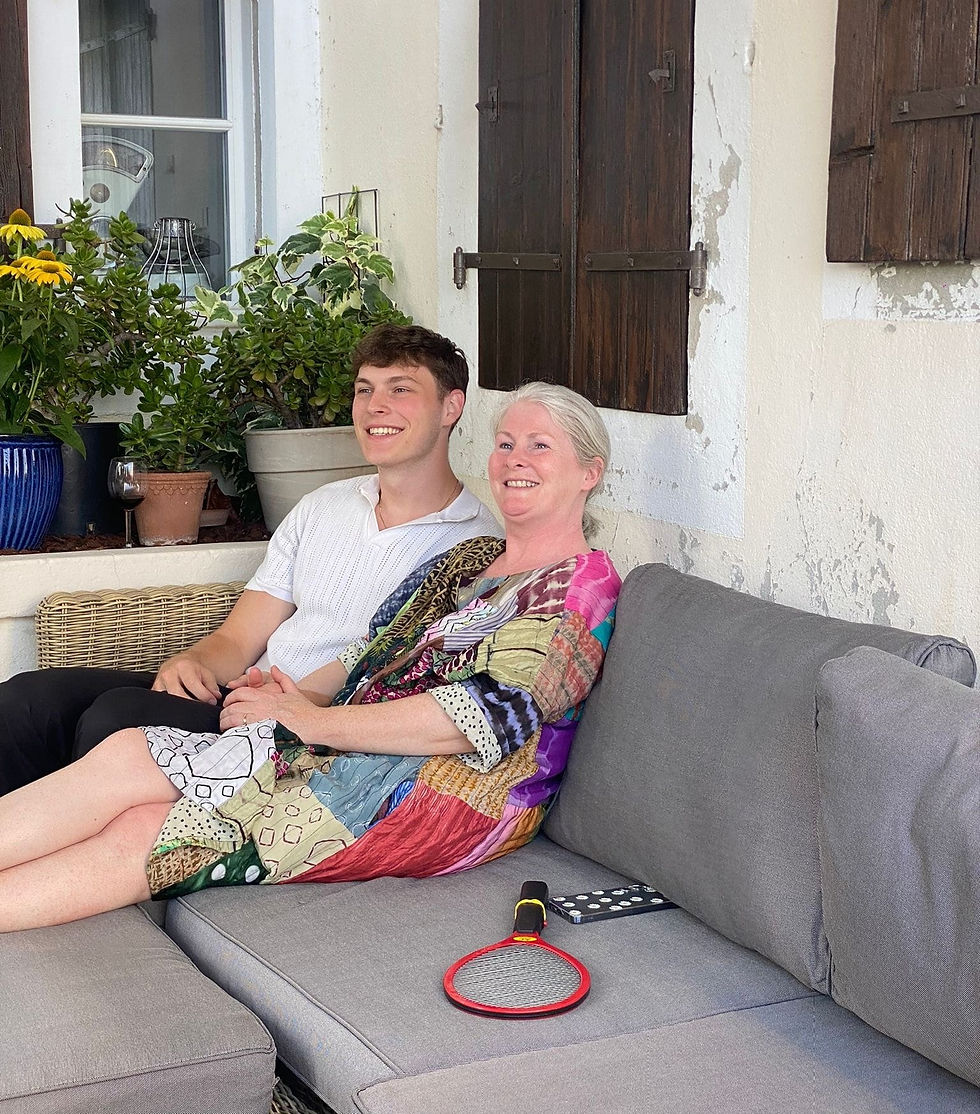
His parents feel it too. “We stay connected with Skype and WhatsApp,” his mother said. “Usually on Sunday afternoons for me, Sunday mornings for him.”
They plan calls around time zones and travel schedules. “Knowing that he’s happy and doing what he wants is enough,” she added.
A Player Who Made Windsor Better
Cheng’s coaching philosophy is rooted in care. “Our mission is to help these guys holistically… As a person first, student second, athlete third.”
He sees diversity on the roster as an asset.
“It’s always good to have people from different paths of life. It enhances the group.”
Aebersold, he said, embodies the program.
“High standard. Competitive. Caring.”
When I asked for one sentence to describe Aebersold as a person, Cheng didn’t hesitate. “Dependable. I could trust him with my own kids.” It’s the kind of line no coach gives lightly.

Looking Ahead: The Professional Dream
Aebersold will graduate this year with a degree in Business Marketing. After that?
“That’s the biggest question mark for me,” he admitted. “I’d love to play professionally in
Europe, whether it be Switzerland or another country… Even somewhere else in the world.”
But he also wants to be closer to family. “Being away so long… I realized how much I miss home. They miss me, and I miss them more.”
He hopes to represent Switzerland one day. “I have three passports: Irish, British, and Swiss. So that helps,” he joked, and wants to give back in the future through youth coaching.
“You can’t play forever,” he said. “If kids enjoy it, coaching is fun. I always want to give back.”
Before I left Cheng, I asked what he hopes Aebersold takes with him long after leaving Windsor. “Mature as a person,” he said. “Develop as a student. Leave the program better than you found it.” He paused. “And he has.”
What Home Means Now
With each passing year abroad, the idea of home shifted. Gyms became anchors, teammates
became family, and airports became commonplace. Still, nothing replaced the pull of
Switzerland. For Aebersold, home isn’t a place he left. It’s a place he plans to return to, stronger than ever.
I asked Aebersold what home means to him. “When I was 18, I didn’t think about it. But now… being away made me realize how much I missed it. You don’t realize what you have until it’s not there.”
He looked down, letting the words settle.
His journey began as a five-year-old chasing a basketball instead of a tennis ball. It brought him through prep school, through a difficult college stop in the U.S., across a border to a new
country, through a redshirt year, through an injury that nearly changed everything, and now to the edge of a professional dream.
It’s a long way from home, but in every gym he enters, from Geneva to Bridgton to Fredonia to
Windsor, one thing has stayed true.
Aebersold shows up early. And he shows up the same, every day.
Dependable.


Great kid through and through
Amazing!